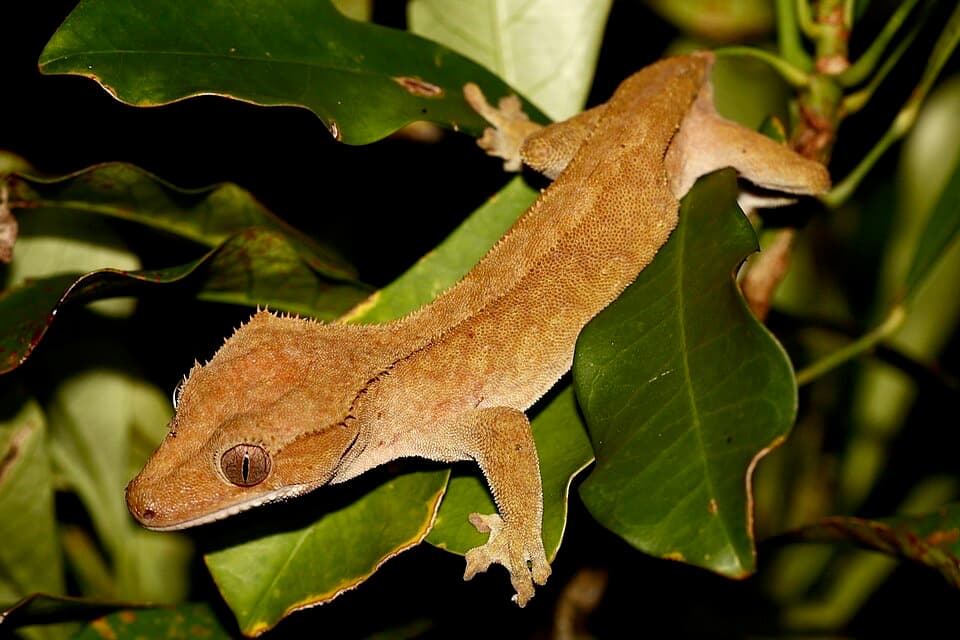
Crested gecko
Also known as Eyelash gecko, Correlophus ciliatus
- Adult size
- 18–23 cm long including tail
- Lifespan
- 15–20 years
- Origin
- Southern New Caledonia
- Company
- Usually best alone; males fight and should never share
- Agile
- Nocturnal
- Gentle
- Jumpy
About the Crested gecko
Crested geckos are tree-dwelling lizards named for the fringed crests that run from above each eye down the neck. They were believed extinct until they were rediscovered in New Caledonia in 1994, and nearly every crested gecko kept today descends from captive breeding.
They are popular because they do well at normal room temperatures in many homes and eat ready-made powdered diets as well as insects. They are lively jumpers rather than lap pets, and an adult that has lost its tail will never grow it back, which is very common and not harmful in itself.
Temperament
Crested geckos are generally gentle and rarely bite, but they are quick and like to leap from hand to hand. They are mostly nocturnal and spend the day tucked into foliage. Young geckos are flighty and settle with age and calm, brief handling.
Enclosure, heat & light
Height matters more than floor space: an adult needs a vertically orientated terrarium of at least around 45 x 45 x 60 cm, filled with branches, cork and live or artificial plants. They prefer roughly 22–26 °C and can suffer heat stress if temperatures stay much above 28 °C, so a thermometer is essential and supplementary heat is only needed in cold rooms. Mist in the evening so humidity rises at night and dries down partially by day, as permanently soggy conditions encourage mould and skin problems. Low-level UVB with shaded areas is now widely recommended, and a bioactive soil substrate or paper towel both work well.
Diet
A complete powdered crested gecko diet mixed with water forms the base of most captive menus and should be replaced before it spoils. Add gut-loaded, calcium-dusted insects such as small crickets or roaches a couple of times a week for variety and protein. Fruit-only diets cause deficiencies and metabolic bone disease. Offer food in a raised ledge dish, as they rarely feed from the floor.
Enrichment & handling
Changing the layout of branches and plants occasionally gives a crested gecko new climbing routes. Live insects encourage hunting and pouncing. When handling, let the gecko walk from one hand to the next in a 'hand-walking' motion low over a soft surface, as falls and grabs can injure them or cause the tail to drop.
Shedding & hygiene
They shed every few weeks and usually eat the skin; good night-time humidity prevents stuck patches on toes and the tail tip. Wipe glass and remove spoiled food and droppings regularly. Wash hands after handling and after cleaning the enclosure.
Health
The most common problems are metabolic bone disease from unsuitable diets, floppy tail syndrome where the tail flops over the body when resting upside down, and heat stress. Retained shed and mouth injuries from jumping at glass also occur. An exotics vet can check weight, bone strength and calcium sacs.
Prone to
- Metabolic bone disease
- Floppy tail syndrome
- Heat stress
- Retained shed
- Permanent tail loss
Call a vet if you notice
- Kinked spine, bent limbs or a rubbery jaw
- Refusing food for over two weeks with weight loss
- Lethargy and gaping in a hot roomEmergency
- Swollen or crusty mouth
- Dark, constricted toe tips after a shed
A vet with experience of exotic pets is best placed to help. Find one before you need them.
Common questions
Do crested geckos need a heat lamp?
In many homes they don't, because they prefer room temperatures in the low to mid 20s °C. If your room falls below about 20 °C at night or stays cool in winter, a low-wattage heat source on a thermostat at one end of the enclosure can help.
Will my crested gecko's tail grow back?
No. Crested geckos lose their tails permanently, and many adults in captivity are tailless. They live normal lives without one, but handle gently to avoid it.
Can crested geckos eat fruit?
Small amounts of soft fruit can be an occasional treat, but fruit alone lacks protein, calcium and vitamins. A complete powdered diet plus dusted insects is far safer.
Why is my crested gecko not eating?
Common reasons are recent rehoming, temperatures that are too cool or too hot, or seasonal slowing in winter. If weight is dropping or the gecko is lethargic, a vet check is wise.
Written by the Petopedia editorial team to our editorial standards. General guidance, not veterinary advice.