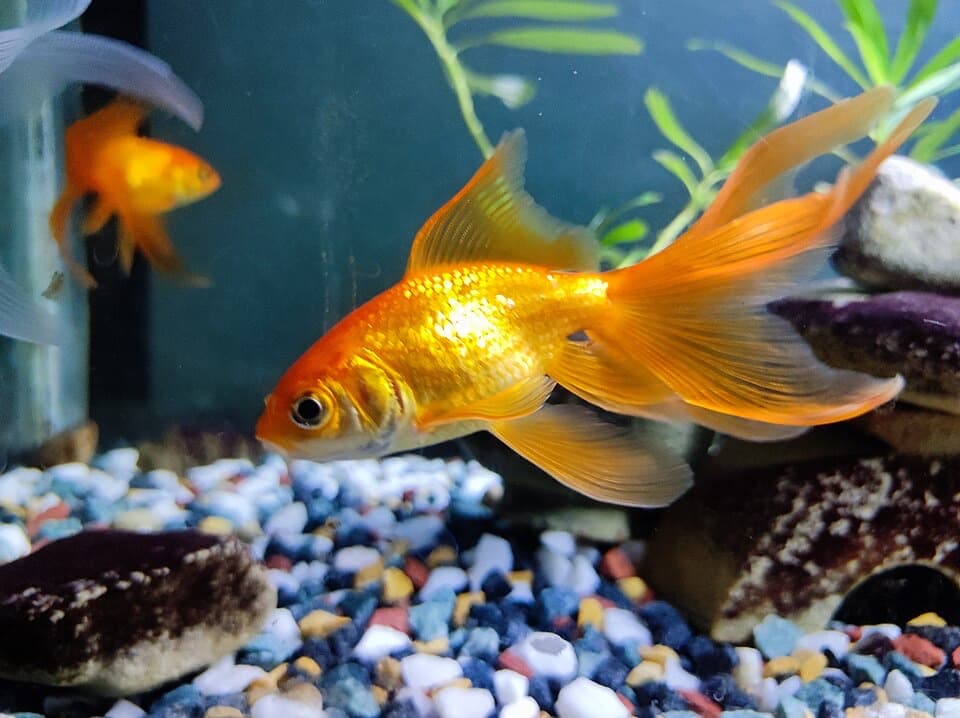
Fancy goldfish
Also known as Fantail, Oranda, Ryukin, Ranchu, Moor
- Adult size
- Usually 10–20 cm
- Lifespan
- 10–15 years
- Origin
- China, with many varieties later developed in Japan
- Company
- Keep with other fancy goldfish, not with fast single-tailed types
- Gentle
- Sociable
- Greedy
- Long-lived
About the Fancy goldfish
Fancy goldfish are the round-bodied, double-tailed varieties of goldfish, including fantails, orandas with their raspberry-like head growth, ryukins, ranchus, black moors and bubble-eyes. They descend from wild carp-like fish that were kept and bred in China for many centuries, with Japanese breeders adding further varieties.
Their compact bodies and flowing fins make them slower and clumsier swimmers than common goldfish. That makes them better suited to aquariums than ponds in most climates, but it also means they cannot compete for food with faster fish.
Fancy goldfish are long-lived and grow much larger than people expect, often reaching the size of an adult's palm or bigger. They are heavy waste producers, so good filtration and plenty of water volume matter far more than ornaments.
Temperament
Fancy goldfish are peaceful, sociable fish that are happiest with other goldfish of a similar type. They should not be kept with fast single-tailed goldfish such as comets, which outcompete them for food. Most tropical fish are poor companions because of the temperature difference, and small fish may be swallowed. Varieties with delicate eye sacs or head growths need especially gentle tank mates and smooth decor.
Tank & water
Despite the old image of a goldfish bowl, fancy goldfish need a large tank; a common guideline is at least around 100 litres for a pair, with more for each extra fish. They are coldwater fish that do well at roughly 18–23°C, so a heater is usually unnecessary indoors, though avoid sudden swings. A powerful, well-maintained filter is essential because goldfish produce a lot of waste. Use smooth gravel or sand, rounded decor and sturdy plants, avoiding sharp edges that can damage eyes and fins.
Diet
Fancy goldfish are omnivores and should have a good-quality sinking goldfish pellet or gel food as their staple. Sinking foods help reduce the gulping of air at the surface, which is thought to contribute to buoyancy problems. Blanched peas (skins removed), leafy greens and small frozen foods add variety. Feed small amounts once or twice a day and resist the urge to give more, as they always behave as if hungry.
Behaviour & tank mates
Goldfish are more intelligent than their reputation suggests and can learn feeding routines and recognise their owners. They enjoy foraging through sand or gravel, so scattering sinking food encourages natural behaviour. Live plants give them something to graze, though they may nibble or uproot softer species. Keep them in groups of their own kind, as they are social fish.
Tank maintenance
Plan on changing around a quarter to a third of the water every week, vacuuming the gravel as you go, because goldfish foul their water quickly. Clean filter media in old tank water and test ammonia, nitrite and nitrate regularly.
Health
The rounded body shape of fancy goldfish makes them especially prone to swim bladder problems, where the fish floats, sinks or swims sideways. They can also suffer from white spot, fin rot, bacterial infections and dropsy, and varieties with head growth or eye sacs can develop infections or injuries there. Many problems trace back to water quality, so test the water first and then seek help from an aquatic vet or experienced aquatic specialist.
Prone to
- Swim bladder problems
- White spot (ich)
- Fin rot
- Dropsy
- Infections of head growth (wen) or eye sacs
Call a vet if you notice
- Gasping at the surface or sitting motionless on the bottom — test the waterEmergency
- Floating upside down or unable to stay upright
- Swollen body with raised scales
- Red streaks in the fins or ulcers on the body
- Burst or cloudy eye sacs
- Not eating for several days
An aquatic vet or experienced aquatic specialist is best placed to help. Find one before you need them.
Common questions
Can fancy goldfish live in a bowl?
No. Goldfish grow large, live for many years and produce a lot of waste, which builds up quickly in a bowl. A spacious filtered tank is needed for them to stay healthy.
Why is my goldfish swimming upside down?
This is usually a swim bladder problem, which is common in round-bodied varieties. It can be linked to diet, water quality or internal illness, so test the water and ask an aquatic vet or specialist for advice.
Can fancy goldfish go in a pond?
Some hardier fancy types can live outdoors in mild weather, but most do better indoors. Their slow swimming makes them vulnerable to predators and competition, and many varieties cope poorly with cold winters.
Do goldfish need a heater?
Usually not in a heated home, as they are coldwater fish. Some keepers use a heater set low to keep temperature stable for delicate fancy varieties.
Written by the Petopedia editorial team to our editorial standards. General guidance, not veterinary advice.