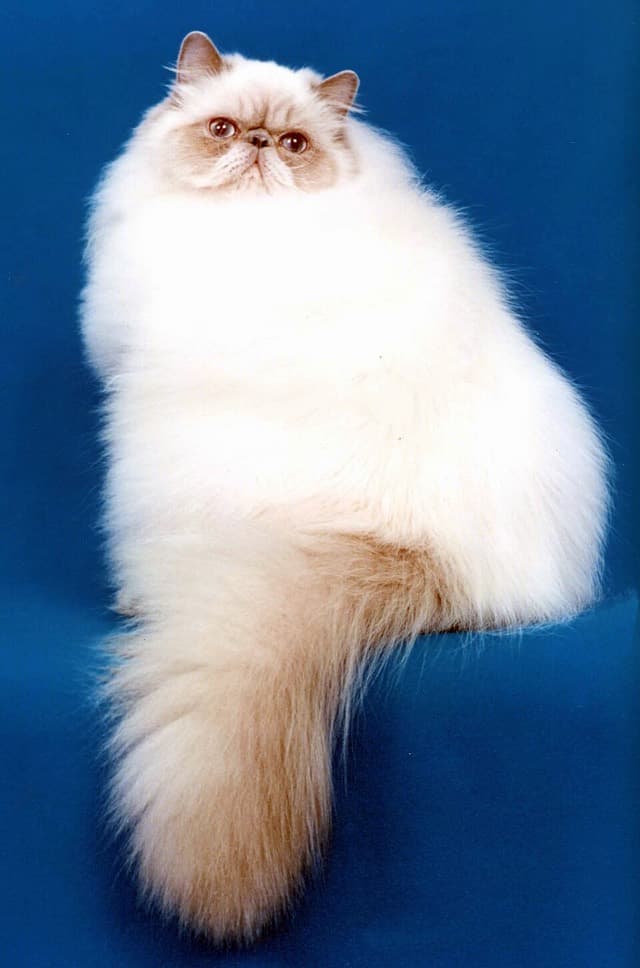
Himalayan
United States
- Size
- Medium
- Weight
- 3–5.5 kg
- Life expectancy
- 10–15 yrs
- gentle
- calm
- affectionate
- quiet
Weights are typical adult ranges; individual cats vary.
About the Himalayan
The Himalayan combines the Persian body and coat with the Siamese colourpoint pattern. It was developed by crossing the two breeds in the mid-twentieth century and breeding back to Persians. Many registries now treat it as a colour division of the Persian. It has a long, thick coat, pointed colouring on the face, ears, legs and tail, and blue eyes.
Temperament
Gentle, calm and affectionate, sometimes with a slightly more playful streak than other Persians. Himalayans tend to prefer a peaceful home and predictable routine.
Play & activity
Low energy. Gentle play with feather toys and short sessions are plenty. They are not usually climbers or jumpers.
Grooming
The long coat mats easily and needs daily combing. The face often requires daily cleaning around the eyes, and occasional bathing may help.
Care & wellbeing
Flat-faced lines can have breathing problems, eye conditions and tear staining, and are sensitive to heat. Polycystic kidney disease is inherited from Persian lines. Regular grooming is a welfare need, not a cosmetic one.
Daily needs at a glance
For a typical 4.3 kg adult- Water
- 172 ml–258 ml
- a day
- Energy
- ≈ 250 kcal
- a day, neutered adult
- Active play
- 15–20 min
- a day
- Grooming
- Daily brushing
Starting points from the same formulas as our calculators. Your pet's age, weight, activity and food all change the numbers. Work it out for your pet
Living with a Himalayan
Typical tendencies for the breed. Upbringing, training and the individual matter as much.
History
The Himalayan was created by crossing Persians with Siamese to combine the long Persian coat with Siamese colourpoints. Some registries treat it as a Persian colour variety. It is placid, gentle and needs daily grooming.
Health
The breed can be prone to
- Polycystic kidney disease (PKD)
- Breathing and eye problems linked to a flat face
- Skin problems
Health tests to ask a breeder about
- PKD DNA test
- Heart scans for HCM
Not every Himalayan is affected, and this isn't a diagnosis. Read about common conditions and when to see a vet.
Cost to keep
Higher than average- Moderate food and insurance costs
- Regular professional grooming adds up
- A 10–15 year commitment
- Budget for breed-related health checks or insurance
A relative guide, not a price — costs vary a lot by country, insurer and lifestyle.
Is a Himalayan right for you?
Could suit
- Quieter homes and relaxed routines
Think twice if
- You don't have time for frequent brushing or the cost of professional grooming
- You can't keep up with daily eye and face cleaning — flat-faced cats are prone to tear staining, eye and breathing problems
Common questions
How big does a Himalayan get?
Adult Himalayans typically weigh around 3–5.5 kg. Individuals vary, and males are often larger than females.
How long do Himalayans live?
Typically 10–15 years. Keeping them lean, active and up to date with vet checks gives the best chance of a long, healthy life.
How active is a Himalayan?
Expect to spend around 15–20 minutes a day on play, ideally in short sessions with toys they can chase and pounce on.
How much grooming does a Himalayan need?
Daily brushing, plus regular professional grooming or clipping. Check ears, teeth and nails as part of the routine.
Are Himalayans affectionate?
Usually friendly, with a balance of company and independence. Every cat is an individual, and early handling shapes how sociable they become.
Do Himalayans shed?
A lot, especially in seasonal moults. Regular brushing keeps loose hair under control — expect more around spring and autumn.
Are Himalayans good with children?
They usually do well with children. Always supervise young children with any cat, and teach them to give the cat space.
Can a Himalayan live in a flat?
Usually, yes — with plenty of play, climbing space and enrichment.
What health problems do Himalayans have?
The breed can be prone to polycystic kidney disease (pkd), breathing and eye problems linked to a flat face, skin problems. Not every Himalayan is affected — ask a breeder about health testing, and your vet about what to watch for.
Written by Petopedia as general guidance, not veterinary advice.